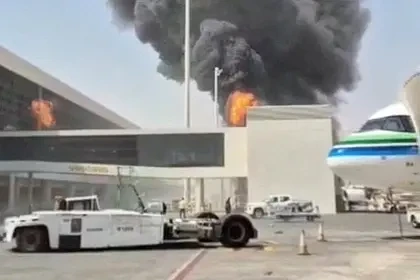
Reuters reported that, for reasons unknown, Saudi Arabia stopped issuing air-raid alerts to the public in the days leading up to a series of attacks on Riyadh airport. These attacks resulted in at least 18 deaths and over 300 injuries.
Riyadh has been targeted four times in the past week, yet the government has not explained why it failed to warn the public beforehand.
Saudi Arabia is engaged in a conflict with Yemen’s pro-Iran Houthi movement. While the kingdom sought to project an image of normalcy to its citizens and the outside world, previous alerts had highlighted the violence associated with the war.
Four Western and Arab officials based in the region, along with political analysts, told Reuters that the lack of warnings prior to the airport attacks raised questions about Saudi Arabia’s ability to fend off assaults and ensure the safety of residents and travelers. They believe this also reflects the government’s attempt to maintain a facade of business as usual.
Sultan Alamer, a US-based Saudi scholar and senior resident fellow at the Middle East Policy Council, said: “The Saudi government wants to have it both ways: launching military operations while simultaneously trying to reassure the public and relevant external parties.”
Some regional analysts argue that this approach could backfire, as the absence of alerts actually makes the public more anxious.
On Monday, Saudi Arabia’s Civil Defense issued its first alert since September 29, warning of potential threats to Riyadh and southern cities. Reuters could not confirm whether the resumption of alerts was a response to the airport attacks, and the Saudi government did not immediately respond to requests for comment.
Sudden Silence from the Early Warning System
Since the outbreak of hostilities involving the US and Iran in February, nations across the Persian Gulf have faced attacks by Iranian drones and missiles, though government approaches to warning the public have varied.
Qatar’s Ministry of Interior sends mobile phone alerts before almost every attack—including one as recently as July—advising residents to stay indoors and away from windows. Bahrain and Kuwait have frequently sounded alarms, urging people to seek shelter.
In May, Saudi Arabia began using a national early-warning system to issue threat alerts via mobile phones and social media accounts. However, while attacks by the Houthi movement had been growing increasingly frequent prior to last week, the warning system suddenly went silent.
According to a post on the Civil Defense agency’s X account, the last alert issued before the attacks last week was on September 29, covering the southern province of Najran.
Two officials with direct knowledge of the matter stated that, prior to the airport attacks last week, an official from a Western ally had asked Saudi Arabia why it had stopped issuing alerts. The Saudi side replied that the alerts were too disruptive, noting that many citizens had complained about being woken up at night.
Michael Ratney, the former U.S. Ambassador to Saudi Arabia, noted that Riyadh was attempting to strike a balance between informing the public about attacks and avoiding disruption to daily life—but the result was that the public became even more anxious about the attacks.
“The way they communicated with the public seemed to reflect the dilemma they faced: the need to respond to the Houthis without disrupting social order,” he said. “Yet, the lack of warnings before Houthi attacks created the very anxiety they sought to avoid.”
Vast Territory Makes Comprehensive Air Defense Difficult
Ali Shihabi, a Saudi analyst with close ties to the government, stated that regardless of whether early warnings are issued, the country’s vast territory makes it difficult to protect every facility.
“There are simply too many places in Saudi Arabia that need protection,” he said. “The country is vast, with airports, pipelines, and oil facilities; air defense coverage is insufficient to protect everything simultaneously, and there are not enough Patriot air defense systems, interceptors, and launchers to cover all these sites.” He added, “There is no limit to Saudi Arabia’s need for air defense.”
Western Embassies Issue Their Own Internal Alerts
Three informed sources and alerts obtained by Reuters indicate that, during this period, Western embassies in Saudi Arabia continued to issue internal missile and drone alerts to their staff.
One source stated that these alerts synthesized intelligence from the U.S. and other Western governments with information provided by Saudi authorities.
The sources noted that embassies had issued alerts to staff around the time of the first two airport attacks last week; however, prior to the airport attack on Saturday, even the embassies themselves had not received any internal advance warning. They did not specify the reason, and Reuters could not confirm, why there was no warning prior to this attack—the deadliest of the past week.